Mount McKinley | Denali Planning
20,310FT / 6,190M | AlaskaPaperwork
Please return the requested paperwork as soon as possible.
- Alpine Ascents Application & Release
- National Park Service Registration & Climber’s Permit
National Park Service Registration and Climber’s Permit:
This is a two-step process. Step one is completing the Application for Special Use Permit, which is required for the climbing permit, and returning it to Alpine Ascents.
- APPLICATION FOR SPECIAL USE PERMIT: Climbers must complete the Denali National Park and Preserve Application for Special Use Permit. The application form must be signed, dated and emailed to Alpine Ascents.
- On the Application for Special Use Permit, use the following answers:
- Organization– Alpine Ascents International
- Proposed Activity– Mount McKinley | Denali West Buttress with Alpine Ascents International
- Preferred Date– list your expedition start date (refer to your confirmation email)
- Alternative Date– N/A
- Maximum Number of Participants– 12
- Individual in Charge– Your lead guide’s name (last, first). Please refer to the Mount McKinley | Denali page for your guide
- Cell Phone No of individual in charge– 206-378-1927
- You do notneed to list alternative dates for this program
- The second step is payment for the climbing permit. We expect the cost of the permit to be approximately $450 ($350 for climbers 24 and under) for the 2027 season. We should have updated permit costs in fall 2026. Alpine Ascents will pay for the permits, and collect the money from climbers beginning in mid-April.
Please don’t hesitate to reach out with any questions! We are happy to help.
National Park Service Expedition Planning Tools:
Review the other information from Denali National Park covering the essentials of expedition preparedness:
Climbing in Denali National Park
Trip Insurance & Evacuation Coverage
We strongly recommend purchasing trip insurance. Even with the best planning, unexpected circumstances — such as an injury or family emergency — may prevent you from joining your trip.
Trip Insurance Info (opens in new tab)
The food is nothing but top notch.
Not only did Alpine Ascents serve quality food, always keeping it new and fresh, warm and desirable but they always had extra for the hungry men that needed more. After interacting with other groups on the mountain- I was nothing but proud and grateful for the level of meals we were provided on a daily basis.
Meet Times & Transport
We meet in Talkeetna, Alaska at 9:00 am on Day 1 of your climb. You will need to book two nights in Talkeetna (the night before your trip date and day 1), which is approximately 100 miles north of Anchorage (2 hour drive). Talkeetna is a very small town with limited facilities; we advise that you arrive there with all your food and gear for the climb already purchased.
From Anchorage to Talkeetna
Fly to/from Anchorage, Alaska (ANC). Flight reservations should be made as soon as possible.
Arrival: You should arrive in Anchorage one day before your climb start date, landing by 4:30 pm at the latest. You may also consider arriving an extra day early to chase lost luggage and have a day to relax. All climbers should make a reservation with one of the shuttle services listed to transport you from Anchorage to Talkeetna. Please make your shuttle reservations soon after purchasing your flights, as this shuttle can get fully booked.
We recommend you stay in Talkeetna the night before your climb begins. We advise booking your accommodations well in advance. Talkeetna hotels and lodges can fill up quickly during summer months.
Please download WhatsApp to your cell phone before arriving in Alaska. The evening before your Gear Check in Talkeetna our staff will start a group text message thread on the WhatsApp messaging app including all climbers as well as your lead guide. Please download WhatsApp and look out for our message the evening before your Gear Check.
Departure: Plan to depart from Talkeetna the day after the final day of your climb itinerary. All flights out of Anchorage should be scheduled after 1:00 pm. With extra days built into the climbing schedule, it is difficult to predict your actual departure date. We do not recommend booking a hotel and shuttle post-climb. We will assist with making those arrangements when you come off the mountain. Transportation arrangements back to Anchorage from Talkeetna can be made with Talkeetna Taxi or Denali Overland shuttle service once you’ve flown back from the glacier.
Delays: Flights to and from the glacier are subject to delays at any time. Please note the possibility of having to remain on the ice or in Talkeetna for an extended period, and ensure your flight arrangements can be changed.
Climbers are responsible for arranging their own lodging and travel arrangements in Talkeetna.
8:00 am Meeting Day 1 of Climb
The Alpine Ascents van will pick climbers up from their hotels at 8:00 am on Day 1 of your climb and shuttle to our facility. Orientation will start at 9:00 am at the Alpine Ascents facility, located just outside of Talkeetna. If you are driving yourself, this drive is approximately 15 minutes.
Climbers can store any personal belongings at our Talkeetna facility for the duration of their expedition.
Lodging in Talkeetna
Staying downtown will give you access to the small shops and restaurants on Main Street. Our Alaska Operations staff will pick you up in Talkeetna and shuttle you to the Alpine Ascents facility outside of town. Please be aware that there are no standard taxi/ride-share options in Talkeetna.
You are responsible for booking your own accommodations for the night before your climb starts and night 1 of your itinerary.
Some hotels we are familiar with are recommended below. You are welcome to find others in the same general area. Please let us know where you choose to stay so that we can schedule a shuttle pickup for you, if needed, on Day 1 of your climb.
Downtown Area
Talkeetna Inn
talkeetnainn.com
Traditional, affordable rooms with forested grounds right on the Susitna River waterfront a few blocks from Main Street.
Talkeetna Cabins
talkeetnacabins.org
A grouping of cabins that each fit 3-5 people, great for climbers who are traveling in a group.
Latitude 62
latitude62.com
Budget-friendly rooms with a rustic feel. The people are friendly and the place is clean.
Talkeetna Hideaway
talkeetnahideaway.com
Talkeetna East Side Cabins
talkeetnaeastsidecabins.com
Swiss Alaska Inn
swissalaska.com
Outside of Town
Talkeetna Alaskan Lodge
alaskacollection.com
One of the largest lodges in the area that will likely have rooms available. More upscale than the downtown options, this lodge is used by the major cruise ship travelers. Located 3 miles out of downtown.
Lodging In Anchorage
Should you need to lodge in Anchorage before or after your climb, the Millennium is a quality hotel that offers free airport shuttle.
Millennium Alaskan Hotel
millenniumhotels.com
8:00 am Meeting (Day 1 of your Climb)
Orientation and gear check will start at 9:00 am on Day 1 of your climb at the Alpine Ascents facility just outside of Talkeetna. The Alpine Ascents van will pick you up in Talkeetna at 8:00 am to shuttle you to our facility. If you are driving yourself, this drive is approximately 15 minutes.
The morning will start with group introductions and an expedition orientation. We’ll then move into a detailed gear check. After gear check, guides will help climbers pick and pack lunch and snack food for the expedition to supplement the lunch food climbers have brought from home. Once all equipment is ready, packs will be weighed and finalized for the flight to base camp.
In the afternoon, guides will review Leave No Trace practices specific to traveling in the Alaska Range, along with camp craft. We’ll then attend the required climber briefing from the National Park Service at the ranger station. The team will wrap up the day with a welcome dinner in Talkeenta, after which climbers will be dropped off at their hotels for an early start tomorrow. Climbers will not have access to their expedition gear or stowed luggage after weighing in at the gear check.
Reminder: Alpine Ascents provides all meals on the mountain, but not in town, including lunch after the gear check.
You are required to attend the gear check meeting. We will distribute and fit rental gear, do a thorough assessment of your gear, provide packing instruction, check personal menu items, and review the route and trip itinerary.
You may attend the gear check in your normal street clothes. We have storage for reasonably sized luggage while you are climbing, so please bring a duffel bag/suitcase to store any personal items you do not wish to take on the mountain.
What to Bring: Please bring all of your gear to gear check. Note that you do not need to pack carefully, as we look at every item together. Rental gear will be picked up at gear check. You are responsible to bring all gear on the Gear List (including food) except what you rent from Alpine Ascents.
Please note that if the forecasted weather prevents flying on Day 2, we may fly onto the Kahiltna Glacier on the afternoon of Day 1.
Gear List
Please refer to your Gear List:
Denali Gear List (opens in new tab)The weather in the Alaska range is unpredictable. With this in mind, we developed our gear list for the wellbeing and comfort of our climbers. There may be occasions when required items are not used because of current weather conditions, and the gear list prepares you for poor weather conditions.
You are required to bring every item on this list as described so be as precise as possible when packing. Alpine Ascents rents quality equipment at reasonable rates. Gear is also available for online purchase at the Alpine Ascents Gear Shop where climbers on an Alpine Ascents expedition will receive a discount.
If renting gear, your rental form must be submitted at least three weeks prior to expedition start date. Please call our office or email [email protected] with any questions.
Note: Gear is virtually impossible to buy in Talkeetna, so it is extremely important that you be fully outfitted before arrival.
Due to the unique nature of Alpine Ascents’ Alaska program, some rental items requested may be picked up in Talkeetna at your gear check, and others may be shipped directly to you prior to your trip. All equipment, whether shipped to you or picked up in Alaska, may be de-issued at the Alpine Ascents Alaska facility at the end of your trip.
Gear Lexicon
If you’re confused by items or language on the Gear List, we encourage you to refer to our Gear Guide for explanations on layering systems, differences between boots, etc.
Gear Guide (opens in new tab)
Organizing for an Expedition to Denali
This expedition is logistics-heavy. The best way to have a comfortable, smooth trip is to understand ahead of time how you’ll pack and move your gear around Denali. You need three different types of luggage for this trip:
- Expedition Backpack – big, comfortable, and ready to hold all of your gear on the upper mountain.
- Sled Duffel Bag – the biggest, burliest duffel available. Think 150-liters in size.
- Small Duffel – carry-on luggage of any kind that isn’t hard-sided nor wheeled.

Stage 1 – Travel to Alaska
Pack everything (except for a few items mentioned below) into your sled duffel and check it in with your airline. Your expedition pack should be flat-packed inside of the duffel bag.
Pack your small duffel as your carry-on, being sure to include any usual comfort items for international air travel. Staying relaxed in the days prior to your expedition will contribute to your success on Denali! Pro tip: we typically fly with our high-altitude boots and our parkas in our carry-on baggage. In the event of lost luggage these items can be difficult to replace last-minute in Anchorage or Talkeetna.

Stage 2 – Trip Prep in Talkeetna
While in Talkeetna, we will conduct a thorough gear check and reorganize our luggage. Here’s how we pack:
- Expedition Backpack – your clothing layers, water bottles, trekking poles, food and snacks for the day.
- Sled Duffel Bag – most of your food, sleeping gear, and tents will go in this bag.
- “Go” Pile – we make a pile of gear we’ll wear onto our flight into Basecamp.
- Small duffel – anything not coming into the mountains, like your street clothes. We can store your personal belongings at our Talkeetna facility for the duration of your expedition. Please note, climbers will not have access to their expedition gear or left luggage after weighing in at the gear check.
Stage 3 – Fly to Base Camp
Fly onto the Kahiltna Glacier, landing at Basecamp (7,100 ft). We are prepared for the cold by wearing plenty of layers. It’s common to wear a hat, gloves, and parkas for the short flight. Upon arrival we will set up basecamp.

Stage 4 – Climbing The Mountain
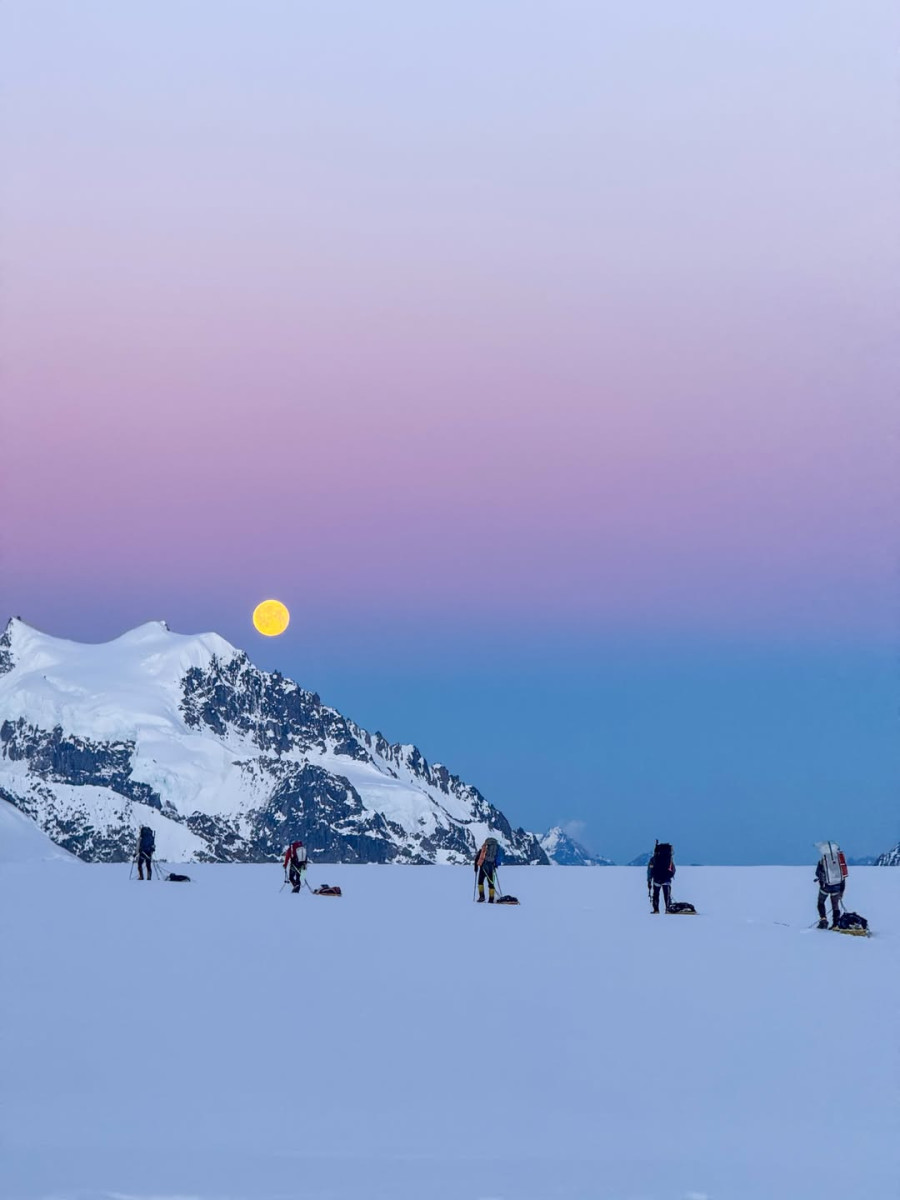
From Basecamp we tow our sled duffels in sleds while carrying our expedition backpacks to Camp I. From here we utilize a series of caches while moving up and down the mountain, allowing our bodies to acclimatize. We leave our sleds and sled duffels behind at Camp III before moving up the fixed lines with everything else we need for the upper mountain in our expedition backpacks.
After the climb has concluded, we’ll reverse the process, all the way back to Talkeetna.
Breakfasts and Dinners Provided
Alpine Ascents will provide all breakfasts and dinners during your expedition, in addition to the snacks listed on the right sidebar of this page. You are expected to bring supplemental lunch/snack food. Lunch is the most important meal of the day on climbing trips, and as the saying goes, “Lunch starts after breakfast and ends at dinner.” It is important that you have lunches you truly enjoy eating in quantity and will give you the proper amount of carbohydrates, fats, and proteins to perform at your best.
Food you need to bring
Plan to bring 42 bars (energy/candy/granola) on this expedition. Each item should have at least 150 to 200 calories and weight approximately 1.5 to 2.5 oz. Mix and match. Pick your personal favorites.
Energy Bars: ProBars, Luna Bars, Cliff Bars, Lara Bars, etc. You should pick your favorites and have some variety in them. Be mindful of their consistency at cold temperatures.
Candy Bars: Snickers, Milky Way, Almond joy, Peanut M&Ms, etc. Pick ones you like and that will not get smashed in your backpack.
Granola Bars and Cookies: Granola bars often do not have as many calories as an energy bar or candy bar. Look at the labels to make sure you are getting the right number of calories.
Energy Gels/Chews: Some climbers like using GU or other energy gels/chews on summit day. If you like these gels/chews (they can be very useful for quick energy) plan on bringing around 6 packets. Honey Stinger Stroopwafels, Shot Bloks, ProBar Bolts, and similar are all good options.
Energy Drinks (strongly recommended): These are small packets of drink mix that you put into your water bottle. They help replenish electrolytes and make it easier for climbers drink more fluids. Especially at altitude when you may not feel like drinking, these are a huge help. Using drink mix is strongly encouraged, though not required. We recommend Nuun, Crystal light, Emergen-C, Gatorade, etc. You may also consider specialized endurance hydration mixes with calories, like Tailwind, Gu Roctane, Skratch Labs, etc., though these are more expensive options. Choose packets that are very small, lightweight, add flavor, and contain electrolytes and other ingredients like vitamin C. If you like these type of drink mixes, plan on one or two packets per day (21 to 42 packets).
Hard Candy (Optional): We also recommend that you bring about 60 individually wrapped pieces of your favorite hard sucking candy (e.g. Life Savers, Werther’s), which help keep your throat from drying out in the dry alpine environment. Ricola Lozenges can also be a good supplement.

On the Mountain
Guides will discuss the importance of personal maintenance, hygiene, and sleeping in cold environments. Guides will teach camp craft and camp setup during the expedition. Climbers will be expected to help participant in camp setup on the mountain.
Nights 2-20 Camping on glacier, Denali National Park
Sleeping arrangements: Tents (2 climbers per tent)
Bathroom: Clean Mountain Cans (CMCs)
Cell coverage: Extremely limited and unreliable coverage at Camps 2 and 3 with AT&T and Verizon. Climbers should be prepared to be out of service for the duration of the climb.
Leave No Trace
Alpine Ascents International practices Leave No Trace principles on all expeditions. We believe that given the proper information most people will do all they can to help protect and maintain the environment. Before your climb, please become familiar with Leave No Trace:
7 Principles of Leave No Trace
As guides, we spend time teaching the environmentally appropriate Leave No Trace principles and practices. There is nothing more rewarding than working hard to get high into the mountains, reaching a pristine campsite, witnessing incredible views, and having the feeling that no one has been there before. Please read the seven LNT principles, and call the office if you have any questions about what you can do to plan ahead.
For more information on environmental stewardship and Leave No Trace climbing ethics, we recommend visiting the Arthur Carhart National Wilderness Training Center.
Leave No Trace – Denali National Park
Clean and ethical climbing on Mount McKinley | Denali requires very specific practices. Please review the practices we will be following on your climb at the link below:
Clean Climbing on Mount McKinley | Denali
Tipping on Mount McKinley | Denali
Our guides make every effort to ensure your climb is risk aware, successful, and as enjoyable as possible. If you have a positive experience, gratuities are an excellent way to show your appreciation. It’s difficult to recommend a specific amount as we believe tips should be based on level and quality of services, as well as an amount that meets your budget. Please consider the information below to be a general recommendation.
8-12% of the total trip cost per guide team is a standard guideline. These amounts cover all guides on your program and are shared equally. Any contribution to the guides’ tip pool can be given directly to the lead guide on your program and will be appreciated by the entire team.
You are welcome to tip with cash, check, or via mobile payment such as Venmo or PayPal. We are unable to process tips by card. If you tip by check, you can make it out to the lead guide by name. Please do not make the check out to Alpine Ascents. Feel free to call our office to discuss tipping in more detail.

Land Acknowledgement and Indigenous Name
We acknowledge we gather upon the ancestral lands of the Dena’ina Elnena, Koyukon, Upper Kuskokwim, Tanana, and Ahtna tribes [known greatly as the Athabascan tribes]. These communities have lived on and stewarded the lands surrounding Deenaalee [The Koyukon tribe original spelling of Denali] since time immemorial, and continue to do so today. We recognize that this land acknowledgment is one small step toward true ally-ship and we commit to uplifting the voices, experiences, and histories of the Indigenous people of this land and beyond.
History of Denali
The name Denali derives from the Koyukon language word “deenaalee” meaning “the Great one”. The Koyukon tribe resides on the North side of the park. There are five Athabaskan languages within the park, each has their own significance and name for the highest mountain in the North American range. Below is an audio transcription of the Nenana tribe’s creation story of Denali (Transcribed from Chief Mitch Demientieff of Nenana’s reading Eielson Visitor Center 2008)
“Long before Denali was created, there lived in Alaska an Indian named Yahoo. He possessed great power but had no wife. Yahoo built a canoe and paddled west to find one. As he approached the raven chief village, he began singing a song that explained that he was seeking a wife.
The wife of the second chief spoke softly: “You may have my daughter for your wife, but take her and go quickly. The raven chief is preparing to kill you!” Yahoo began to paddle away with the young woman. The raven chief was right behind him. The raven chief caused a great storm. The water became very rough. Yahoo took out a powerful stone and threw it ahead of him, calming the waters, but mountainous green waves continued to roll behind him.
Next the raven chief threw his great spear at Yahoo, but Yahoo, using medicine, changed the large wave behind him into a mountain of stone just in time. The great spear glanced off the crest of the stone mountain. There was a second tremendous wave of water, even greater than the first. Yahoo used all his medicine to turn this wave into a tremendous mountain of stone. When the great spear hit the top of the mountain, there was a crash of breaking rock, and the great spear flew off into the sky.
The raven chief was paddling so quickly, his canoe struck the second great mountain of stone. The raven chief was thrown onto the rocks, where he changed instantly into a raven and flapped to the top of the mountain. Exhausted, Yahoo fell asleep. When he awoke he was back at home with his new wife at his side. Gazing around, Yahoo saw the two mountains he had created. There was a smaller one to the west now called Foraker, but the larger one, the one the great war spear glanced off before shooting into the stars, that mighty dome would be called – Denali! The Great One!
Yahoo looked at the sky to see the great raven happy to be back with his people, dancing his approval in the wind.
History of Alaskan Tribes
Since the last Ice Age, Native American tribes have called the land surrounding Denali home. The land of Alaska provides little comfort. Alaskan indigenous cultures have skillfully and expertly adapted their ways of life to meet the demands of the changing environment. The arctic environment provides no livestock suitable to be domesticated, or land to plant crops. The tundra environment is harsh and lends itself only to a hunter gatherer nature, tribes have survived and thrived upon this land for millennia. During the gold rush when settlers began to flock to Alaska, they often found themselves overwhelmed by the harsh landscape. The success of many gold panners and trading routes was due to the activity and support of indigenous tribes. They often helped provide furs for trade, aided exploratory teams in crisis, and maintained centers for travelers to visit on their journeys to gold panning sites. Due to the remote location of Alaska, and the slow movement of the US to urbanize the state, there were no treaties created. Indigenous tribes still occupy a large amount of the land they have lived on for millennia.
Alaska Indigenous Community Educational Resources
View the Culture and Heritage educational resources from Denali NPS
The Denali NPS website has great articles written on the History and Culture of the park
Watch our in depth discussion of our Mount McKinley | Denali Expedition
Reading List
This is a highly recommended shortlist and we would be happy to pass on a longer reading list for those interested. These links will bounce to Amazon.com with reviews.
For additional reading, please visit this recommended list from Denali National Park.
In the Shadow of Denali : Life and Death on Alaska’s Mt. McKinley
by Jonathan Waterman, The Lyons Press

Mount McKinley : The Conquest of Denali
by Bradford Washburn, Harry N Abrams

The Ascent of Denali : A Narrative of the First Complete Ascent of Mt. McKinley, Highest Peak in North America
by Hudson Stuck

Dena’ina Ełnena, A Celebration
Voices of the Dena’ina

Daddy is Climbing Denali
Samuel Sidiqi