Everest Base Camp Trek
NepalEverest Base Camp Trek
- Nepal - Bhutan
- Pack Weight: 15 LBS
- 20 Days in country
- Gallery
- Dates & Pricing


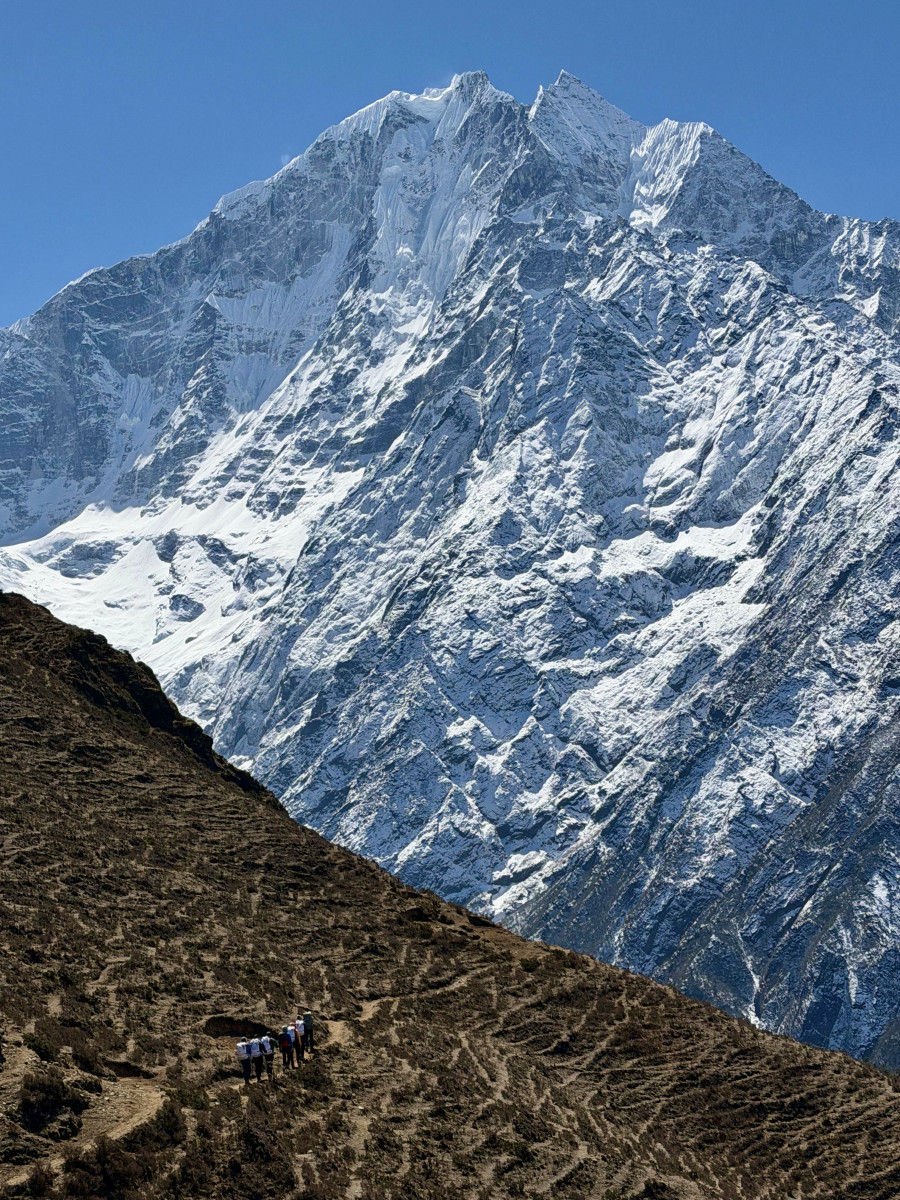
Our Everest Base Camp Trek is a defining journey for travelers, steeped in history, local culture, and unparalleled natural beauty. Perfect for the fit enthusiastic hiker, every day brings new wonders as you follow the famed trail to Everest Base Camp in the shadow of the world’s biggest peaks, Everest, Lhotse, Pumori and Ama Dablam.
Alpine Ascents brings an exemplary experience to our Everest Trek: Our lead guides are not only rich in cultural understanding, but they are Himalayan climbers in their own right. This creates a unique experience where mountain history becomes part of the journey alongside Sherpa culture and daily life in this Buddhist region. Our Everest Base Camp Trek combines awe-inspiring nature with immersion in timeless village life—a rare opportunity in an ever-changing world.
For nearly 40 years, Alpine Ascents has led this trek with a commitment to exceptional guiding standards and local partnership. U.S.-based senior Himalayan guides lead expeditions in close collaboration with highly experienced local Sherpa guides and support staff. This combination of international expertise, long-standing relationships in Nepal, and deep knowledge of the Himalayan environment sets Alpine Ascents apart.
Key Components

Guide Leadership: All trips led by U.S.-based senior mountain guides such as Ben Jones, Ari Todd and Eric Murphy

Air Transport: Travel by helicopter to and from Lukla included (when fixed wing flights are delayed)

Gear Check: Guides take trekkers through a full gear check and tour in Kathmandu

Cultural Focus: Learn about Sherpa village life, Buddhist culture, and climbing history

Meals: All meals, plus welcome and farewell dinners in Kathmandu, are included on the trek

Logistics: All transportation—including helicopter service to and from Lukla when fix-wing flights are delayed. Early departure by helicopter also available

Lodging: Stay in handpicked lodges for all nights during the trek

Safety: Emphasis on safe trekking, health and risk management with highly medically trained guide staff

Private Treks: We offer private treks for those who want to travel individually or on different dates.
Gear Support: Get expert equipment support from our full-time gear department

Side Trip: Visit the Sherpa community and monastery of Thame

Seasons: Treks depart in fall and spring—fall tends to be quieter, while spring includes a night at Base Camp
Training: 1:1 training consultations available

This is our 3rd trek with Alpine Ascents
and we had another great experience with excellent guides! 100% satisfied! An unforgettable experience and adventure which was highly enhanced by our guides knowledge and relationship with the Sherpa culture.
Absolutely amazing!
What a wonderful time we had in Nepal. The trek was colorful, informative, immersive, challenging, and completely fulfilling! It met all of my expectations and more. I didn’t realize just how immersed in the culture and the local people we would be and it was just wonderful. I am mesmerized by the mountains of the Himalaya and have vivid memories now of the spectacular views we had on our trek. It makes me want to go back for more. Every turn was another spectacular view or interesting site or cool animal sighting – just loved it!
Alpine Ascents is top rated. Everything I experienced supports that outstanding ranking. Our guides Vern and Carol were outstanding in every way.
This was a fantastic trip from the start to finish.
The mountain views and learning the cultures of Nepal were both highlights for me. Our guides had a very in-depth and unique understanding of the region, from geology, food, Buddhism, health & wellness of the locals, personal relationships with many of our hosts, and always willing to share a story. This trek was very informative for me.


On the Trail
From the moment you step into the Khumbu, the trail to Everest Base Camp becomes far more than a hike—it becomes a journey into one of the most dramatic and culturally rich mountain landscapes on Earth. At Alpine Ascents, our Everest Base Camp Trek is designed to balance seamless logistics with deep immersion in the people, villages, and rhythms of life in the Himalaya.
Transport: Travel to Lukla is a defining feature of any Everest trek, and we approach it with flexibility and reliability. When conditions permit, we fly fixed-wing aircraft for efficient transport. When weather interferes, our helicopter support is already built into the program, helping reduce delays and unnecessary layovers. We return from the Khumbu to Kathmandu by helicopter, providing both efficiency and a spectacular aerial view of the terrain you’ve just walked through. As an option, those who prefer a shorter hike out after reaching Base Camp may depart from the upper valley by helicopter to conclude the trek.
Trekking & Lodging: On the trail, Alpine Ascents trekkers stay in traditional Sherpa village teahouses—simple, comfortable lodges that provide a window into daily life in the Khumbu. Through decades-long relationships with local partners, we prioritize quality lodging, reliable meals (as available in this remote region), and thoughtful pacing that supports acclimatization and overall comfort. Our Sherpa team is central to the experience, as mountain professionals and as cultural ambassadors who share insight into the region’s history, traditions, and spiritual life.
Spring and fall departures both follow the same classic route to Everest Base Camp. Spring offers the opportunity to experience Base Camp during the active climbing season, while fall is typically quieter, with clear skies and fewer trekkers.

The Alpine Ascents Way
Our approach to the Everest Base Camp Trek begins long before you step onto the trail. From private airport pick-ups in Kathmandu to a thorough, in-person gear check and complete logistical coordination, our goal is to remove friction from your experience. We handle in-country flights, hotels, meals, permits, porter support, and trail logistics with care and precision, so you can arrive on the trail prepared, confident, and fully present for the journey ahead.
Experienced Alpine Ascents guides lead our treks in close partnership with our deeply respected world-class Sherpa team. They are medically trained and selected for their ability to lead with professionalism, calm decision-making, and genuine care for the people they work with. They are also trained educators who actively engage trekkers, sharing insight into Himalayan culture, mountain travel, and the human stories behind the Khumbu region. This blend of U.S. senior guide leadership and deep local expertise creates an experience that is both technically sound and culturally rich.
At the heart of Alpine Ascents International lies a long-term commitment to the communities that host us. Through the Alpine Ascents Foundation, now in its 27th year, we help fund schools and educational initiatives in Nepal, creating meaningful, tangible support for Sherpa families and future generations. These partnerships are built on decades of trust and collaboration. When you trek with Alpine Ascents, you stay in villages where we are known, not as a passing outfitter, but as long-time partners and friends.
This approach—thoughtful logistics, exceptional guide leadership, and a genuine commitment to giving back—defines how we operate in the Himalaya. It’s not just about reaching Base Camp. It’s about how you travel, who you travel with, and the positive impact you leave behind.

Life in the Khumbu
Trekking Region/The Khumbu: Our trekking region is known locally as the Khumbu. The name comes from its guardian deity, Khumbila Tetsan Gelbu, literally translated as “Khumbu country god.” Buddhist teachings speak of a spiritual connection between all beings, which may explain why hospitality and openness toward westerners come so naturally to the Sherpa.
Often inseparable from mountaineering, the Sherpas of Nepal inhabit much of the lower portion of the Himalayas known as the Solu-Khumbu. While their reputation as climbers is nothing short of historic, local Buddhist, animist, and cultural traditions have equally nurtured a fascinating relationship with westerners and western thought.
Sherpas became prominent in the West when British mountaineers began to set their sights on climbing Himalayan peaks. With the first Mount Everest expedition in 1921, the skill, expertise, honesty, and dedication of Sherpas as guides and partners became an integral part of Himalayan climbing. The affinity of outsiders for Sherpa-Buddhist civilization has blossomed into an ever-increasing sharing, understanding, and friendship between cultures.
History of the Region: Prior to British expeditions, Sherpas revered the region’s great mountains as dwelling places of gods and goddesses and considered climbing them blasphemous. (Chomolungma, the Tibetan name for Everest, is home to Miyo Lungsungama, the goddess of humanity and prosperity.)
Sherpas traditionally worked as traders, farmers and religious practitioners. Along with these ancestral roles, leading climbs and treks has recently become a mainstay of the Sherpa economy. “Sherpa” refers both to a tribal group and to an occupation—porter, climber, or trek leader. The term “Sherpa” means easterner, referring to their origins in Eastern Tibet. The migration of this Tibetan culture began sometime in the early 1400s. Today the Sherpa population in the Khumbu is about 5,000 with a total of roughly 250,000 living in Nepal, according to Nepal’s 2021 National Population and Housing Census recorded 250,637 Sherpa individuals.”
On Everest: The first notable and successful Everest climbing Sherpa was Tenzing Norgay. In 1952, Norgay accompanied Raymond Lambert to within 800 vertical feet of the still unclimbed Mt. Everest. A year later Norgay was asked to join the British team led by Col. John Hunt, which successfully summited Everest, following the same route as Norgay and Lambert. Norgay and Sir Edmund Hillary were the first climbers to reach the summit. By the mid-1980s, Sherpas had summited Everest many more times than westerners. Ang Rita Sherpa, the best-known climbing Sherpa, summited Everest nine times without supplemental oxygen by 1995. In 1993, Pasang Lhamu Sherpa became the first Sherpa woman to summit Everest. As of 2026, Kami Rita Sherpa has summited Everest 32 times.


Local Impact
Alpine Ascents International’s history began in Nepal. From our earliest expeditions, we have felt a strong responsibility to the country’s people, land, and culture.
Nepal was far less traveled when we first began visiting in the 1980s. As mountaineering activity increased, Alpine Ascents worked alongside local communities and government agencies to promote cleanup initiatives and Leave No Trace principles. These efforts have included both education and financial support, assisting and funding numerous cleanup projects on Everest and throughout the surrounding region.
In addition to larger conservation projects, our environmental efforts have also included practical changes to reduce the footprint of our own expeditions, such as proper battery disposal, reusable duffle bags for our teams, and introducing SteriPens to reduce reliance on plastic water bottles. Today, we continue to prioritize small teams and low-impact practices at Everest Base Camp, recognizing our responsibility to protect an environment that sees thousands of climbers and trekkers each year.
That commitment extends to the communities of the Khumbu. In 1999 we established The Alpine Ascents Foundation and its subset, The Sherpa Education Fund. These non-profits have provided scholarships, built schools, and helped address educational needs within Sherpa communities. The Foundation covers all administrative costs so that every dollar donated goes directly to local scholarships. To date, more than 100 students have received multi-year scholarship support. Learn more at AlpineAscentsFoundation.org.
Nepal has become a second home for many of our guides and staff. Over the years, we’ve developed lasting friendships throughout the region, and we remain deeply committed to supporting the communities and landscapes that have been such an important part of Alpine Ascents from the beginning.
Frequently Asked Questions
The best time to trek to Everest Base Camp is in the spring, April – May, and the fall, October – November.
The Everest Base Camp Trek is designed for participants who are comfortable hiking on uneven terrain while carrying a 15 lb daypack. Trekkers should have good cardiovascular fitness and be capable of maintaining a steady pace over multiple consecutive days. Because the itinerary reaches elevations of 18,300 ft. / 5,577 m, arriving with an appropriate level of fitness is an important component.
An effective training program for the Everest Base Camp Trek should be primarily composed of endurance training with significant strength components as well. Your training should progress slowly and be modulated, incorporating progressively harder weeks with planned rest weeks to consolidate the training loads into fitness gains. See more details on our Everest Base Camp Trek Training Page.
Our Mount Everest based camp trek begins and ends in Kathmandu, Nepal. For those arriving early or departing after the scheduled itinerary, we are happy to make hotel and airport transfer arrangements. Upon arrival we will pick you up at the airport.
Most days on the Everest Base Camp Trek average 5-6 hours of hiking, with some shorter and some longer days.
Alpine Ascents prepares all water for the Everest Base Camp Trek by boiling. Trekkers will fill water bottles at all meals. Some prefer to supplement this with bottled water which runs from $1- $3/bottle along the trekking route. We prefer that the number of bottles purchased during the expedition be kept to a minimum. Trekkers are also advised to bring steri pens which make potable water easily available.
We are aware of the potential monotony of expedition food and Alpine Ascents makes every effort to make meals a positive part of the trek. Our pre-planned meals use a large shipment of food from the US along with food purchased locally in Kathmandu. We take great care in our meal preparation, understanding the importance staying healthy, fueling effectively, and overall enjoyment. Trekkers will often have the option of eating local food while on the trek to Everest base camp.
Our spring Everest Base Camp includes one night spent at Everest Base Camp.
In Kathmandu, we stay at the high standard Yak & Yeti Hotel. For the lodging during our trek, we stay in Sherpa village tea houses—many of them remote—giving us a rare look into both traditional and monastic communities. While the environs are often primitive by western standards, they are balanced by the tremendous warmth of the Sherpa families. While we do our best to select comfortable lodges, the Khumbu is a remote area and accommodations/toilet conditions are very basic.
Additional costs for the Everest Base Camp Trek can be found on our Price & Policies page.
Please see our Everest Base Camp Trek Planning Page for current immunization requirements and recommendations.
You will need multiple layers of technical clothing and proper footwear, handwear and headwear.
For more information check out our gear list.
In addition to larger conservation projects, our environmental efforts on Mount Everest have also included practical changes to reduce the footprint of our own expeditions, such as proper battery disposal, reusable duffle bags for our teams, and introducing SteriPens to reduce reliance on plastic water bottles. Today, we continue to prioritize small teams and low-impact practices at Everest Base Camp, recognizing our responsibility to protect an environment that sees thousands of climbers and trekkers each year.
Alpine Ascents uniquely provides a US based professional Himalayan climber to lead all Everest Base Camp treks.