Ladakh Nubra Valley Trek Itinerary
Lasermo Pass (17,880FT / 5,450M) | IndiaItinerary

This was a great itinerary blending visits to stunning monasteries with a breathtaking trek through the Indian Himalayas. Combining strenuous outdoor adventure amid epic peaks with the food, culture and uniqueness of Ladakh makes for an unforgettable trip. -2025 Ladakh Trekker
Day 1 – Arrive Delhi
Pick up and transfer to hotel. (The Claridges or similar) Most flights arrive very late at night or after midnight. Please note that the tour begins at 9am day 2. Check in at 2pm, early check in will incur an additional charge.
Day 2 – Delhi Tour
Beginning at 9 am, we will tour Delhi, a city that has been in existence for centuries. From the beginning of time, successive layers of gifted civilizations have left their architectural marks, with the great Mogul Emperor Shah Jahan being India’s architect extraordinaire. We wander or take a rickshaw ride through Chandi Chowk (Silver Street), the colorful market street of ancient Shahjahanabad, now a bustling bazaar, followed with a visit to Raj Ghat where Mahatma Gandhi was cremated.
Our exploration of New Delhi also includes a visit to India Gate, which was built in memory of Indian soldiers killed during the First World War. We drive pass through Rashtrapati Bhawan, which was built in the early 20th century as the Imperial residence of the Viceroy and is currently the official residence of the President of India and Parliament House. This unique circular building with huge colonnades now houses the Upper and Lower Houses of Parliament. Then, we move to Humayun’s Tomb, the first Mughal garden tomb. Visitors are immediately struck by the tomb’s resemblance to its more famous cousin – the Taj Mahal – with its four grand gateways, octagonal base-plan, soaring niche-shaped arches, lofty double domes and the symmetrical garden with its central canal. Overnight in Delhi.
Day 3 – Fly to Leh
We transfer back to the domestic airport for and early morning flight to Ladakh. This is one of the most sensational scheduled flights in the world, taking us right over the top of the Greater Himalaya before dropping down in a series of steep turns, to land at the small military airport at Leh. (flight time 1.5 hours). Leh is blessed with markets, curio shops and is something of a traveler’s mecca. We will be met on arrival and transferred to local hotel. The rest of the day is filled with gentle walks in town and resting to help adjust to the altitude. Overnight in Leh.
Leh altitude: 11,500 ft / 3,500 m
Day 4 – Tour of Ladakh’s famed monasteries and palaces
Shey Palace (15 km from Leh) The old ‘Summer Palace’ of the kings of Ladakh was built about 550 years ago by Lhachen Palgyigon, the first king of Ladakh. It stands next to the remains of a larger construction on the east side of a hill, which runs south-east towards the Indus. From the palace we can see over the fertile Indus plain northeast to Thikse Gompa and over the Indus to the Zanskar mountain range. The old Shey palace has the largest golden Buddha statue in Ladakh in its gompa. The statue is worked out of gold and gilded copper sheets, stands 12 meters high and has blue hair. King Dalden Namgyal erected it in the middle of the 17th century. The most important moment in the construction of such a figure is when the eyes are painted in and the statue can ‘see’. No artist or monk would dare to look the Buddha in the eye so the pupils are painted over the artist’s shoulder, with his back to the idol.
Thiske Gompa (17 km from Leh) The 500-year-old Thikse monastery, perched on a hill high above the Indus, has the largest contingent of monks in Ladakh. On the right of the entrance to the main courtyard a new chapel houses an enormous 15-metre-high seated Buddha figure. About 100 yellow-cap sect monks belong to the gompa. We hope to witness the daily morning prayers preceded by the mournful sounds from the long Tibetan horns on the roof.
Hemis Gompa (45 km from Leh) Hemis Gompa is famous far beyond the borders of Ladakh for beauty and the Hemis annual. This takes place every year with mask dances on the 9th to 11th day of the fifth Tibetan month. Hemis also has a gigantic thangka (Buddhist cloth painting), one of the largest in the world, which is only displayed to the public every 12 years at the Hemis Festival. Hemis Gompa is the largest and one of the most important in Ladakh quite apart from its annual festival. It was founded about 350 years ago by Stagtshang Rinchen, who was invited to Ladakh by King Singe Namgyal.
Each of these monasteries are profoundly beautiful in both architecture and internal artwork. Overnight at the Hotel in Leh.
Shey Palace altitude: 11,204 ft / 3,415 m
Thiske Gompa altitude: 11,800 ft / 3,600 m
Hemis Gompa altitude: 12,000 ft / 3,650 m
Leh altitude: 11,500 ft / 3,500 m
Day 5 – Acclimatization hike Gyamtsa
In the magical land of Ladakh lies this beautiful trail, which begins right outside Leh City and takes one to Gyamtsa through the diverse and arid terrain of the upper Ladakh region. The majority of the trail goes through rocky and rough terrain that only gets tougher with the climbing altitude, where one can also find some snow depending on the season. Apart from that, Nevertheless, this trail is one of the shorter ones and only takes one to Gyamtsa.We can start walking from hotel and slowly head towards Gyamtsa. After completion of walk wil return to Leh for Lunch.
Hiking time: 3-4 hours
Gyamtsa altitude: 12,795 ft / 3,900 m
Leh altitude: 11,500 ft / 3,500 m
Day 6 – Drive to Alchi Gompa
Alchi Gompa is located near the small village of Sashpol. It is one of the earliest monasteries built in Ladakh, dating from the 11th century. Because it was built before the invading wars began in the 15th century, Alchi was built on lowlands, rather than on a hilltop as others were, in order to protect them from marauding armies. King Rin-chen-Izghimpo, one of the first Ladakhi kings to engage in foreign relations, was the builder. Prior to construction, the Ladakhi king signed a treaty with the Gyalpo (king) of Tibet, who agreed to provide the artisans.
The rambling monastery has six main buildings while the temple is surrounded by wooden pillars and carved woodwork of mythological animals. The woodwork is original and reflects Kashmiri influence. The walls along both sides of the Dukhang (inner building) are covered by mural paintings which are probably original to the time of the monastery’s founding. Of particular interest are the miniature scenes of royal life. The best preserved is the royal drinking scene which is one of the most remarkable to have survived anywhere in the Tibetan-speaking world. The costumes in this scene clearly depict central Asian dress and the king and queen each have a halo, a convention that appears elsewhere in Alchi and possibly shows Nestorian Christian influence from Persia. This is the only painting in Ladakh that shows central Asian influence so clearly. The chortens around Alchi gompa also contain numerous wall murals, often of Rin-chen Zang-po, meant to honour his activities as a translator in collaboration with Indian teachers of Buddhism.
After the monastery we drive to Phyang where we will visit Phyang Monastary. Overnight in above Phyang in Morobuk (13,200 ft.).
Leh altitude: 11,500 ft / 3,500 m
Phyang altitude: 11,650 ft / 3,550 m
Morobuk altitude: 13,200 ft / 4,023 m
Driving distance: 66 km in ~1.3 hours
Day 7 – Trek Murbuk
After breakfast we make a gradual ascent to Phyang phu where we camp for overnight. This area is used by local Shepherds during summer for grazing. Great view of the Stok Range from the trek route if the weather is clear.
Hiking time: 3-4 hours
Murbuk altitude: 11,660 ft / 3,554 m
Phyang Phu altitude: 15,161 ft / 4,621 m
Day 8 – Trek Phyang Phu – Side valley hike – Lower Laseramo Base
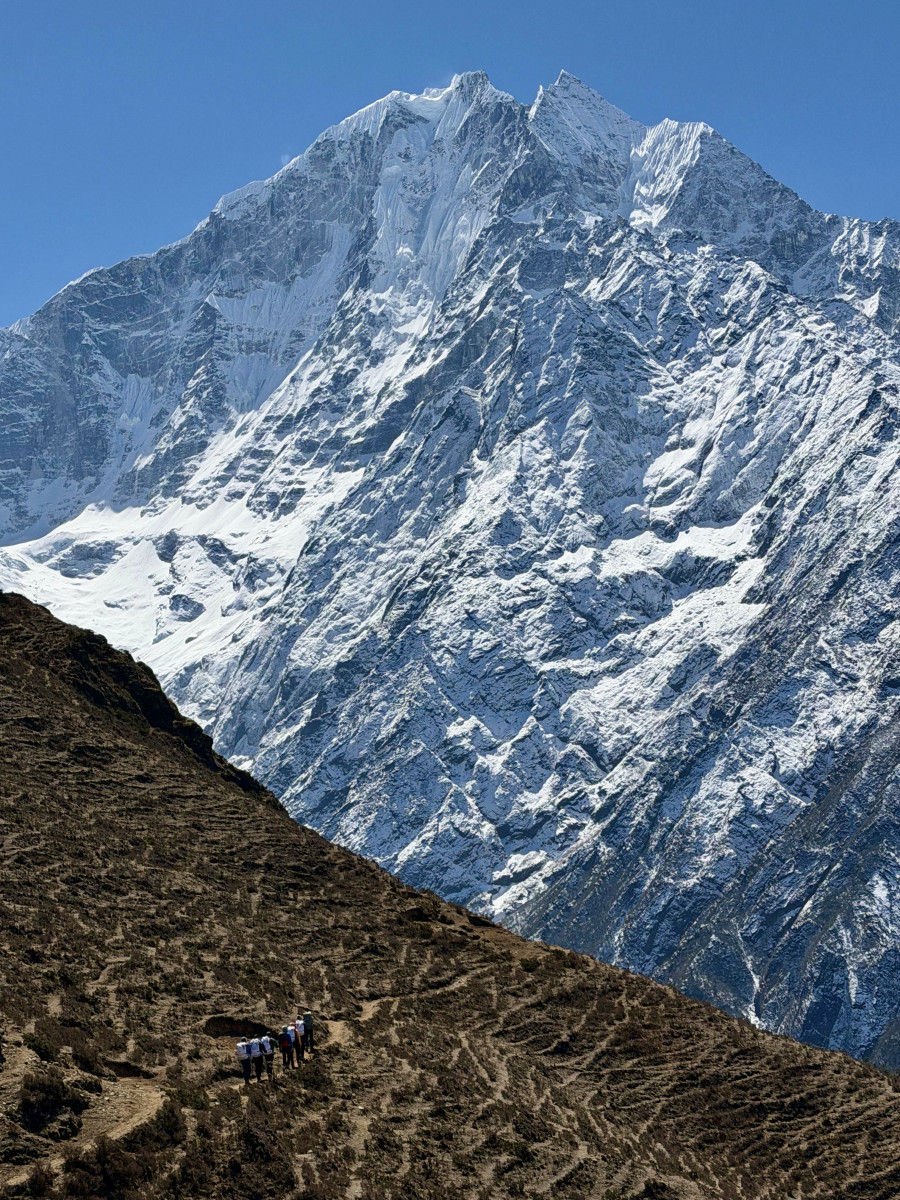
First we cross the small stream and then take the right valley up for acclimatization walk for about 2 – 3 hours. Above along the Luna Chemo Chu (stream), there is a possibility of spotting wildlife along the ridges such as the Himalayan blue sheep and Himalayan wolf in the adjoining valleys. We return to the junction, then as we head towards Lseramo Pass and Camp, glaciers and snowy Peaks start appearing. We arrive at a beautiful campsite along the stream. From here we have a view of complete Stok range especially the Stok Peak at 6,130 m above sea level. Stok range and Ladakh range are where Leh is situated. This area is one of the major routes for crossing the Ladakh range. Overnight in camp.
Altitude: 15,584 ft / 4,750 m
Hiking time: 5-6 hours
Day 9 – Trek Lower Base Camp – Higher Base Camp
After a leisurely breakfast, we will continue our trek to the higher base camp of Lasermo La. Gradual leveled walk along the stream as the valley opens and we get introduced to glaciers and moraines, few small stream crossings to the base just below the terminal Moraine on a nice grassy meadow, Possibility of afternoon hike up the valley for height gaining and acclimatization. Overnight Camp.
Lasermo La altitude: 17,880 ft / 5,450 m
Hiking time: 2-3 hours
Day 10 – Trek South Base of Lasermo – North Base via Lasermola
Today we start quite early in the morning as we need our ponies to cross the small glacier by midday. We will cross the Lasermo Pass (5,400m). The top of Lasermo pass offers stunning panoramic views of the surrounding peaks, the Indus valley and the Shayok Valley. The trail from the pass towards our camp passes rough moraines. The campsite is in a beautiful meadow and offer opportunities to explore and see flowers growing at high altitude.
Lasermo La altitude: 17,880 ft / 5,450 m
Hiking time: 6-7 hours
Day 11 – Trek North Base – Hundar Dok
Today we will walk down through a valley of meadows and flowers. Most of the time, we will be walking alongside the Hundar stream. After following the stream for a while, we will pass through shepherds’ huts, where the men and women from Hundar Dok Village live with their Yaks, cows, goats and sheep. They could be seen collecting milk, cheese, butter, wild vegetables and fuel for the winter. If we are feeling adventurous, we can taste the delicious milk and cheese with Tsampa. Our campsite is just above the Village of Dok Gongma (Upper Dok).
Upper Dok altitude: 13,780 ft / 4,200 m
Hiking time: 7-8 hours
Day 12 – Trek Hundar Upper Dok – Wachan and drive to Hundar
Another beautiful day! We will pass through the villages of Dok Gongma, Dok Yokma and Wachan, which are names of different places with concentrations of scattered houses belonging to a common village known locally as Hundar Dok. Upon reaching Wachan we will board awaiting vehicles and drive to Hundar. Overnight hotel.
Upper Dok altitude: 13,780 ft / 4,200 m
Hundar Dok altitude: 13,310 ft / 4,057 m
Hiking time: 5 hours
Driving time: 1 hour
Day 13 – Explore Hundar Area
Early in the morning drive (7km) to Diskit monastery to witness the morning prayer ceremony. It takes about 15 minutes to reach the main prayer hall of gompa, which is set on the highest point near the village. Belonging to the Gelugpa (yellow hat) sect, parts of the gompa, which houses 120 resident monks, are about 750 years old. The Dukhang has many statues, one of which holds the head and left arm of a Turkish invader believed to be 500 years old. Return to the hotel for breakfast.
After breakfast we drive down towards the Shyok river across an extremely rough and rocky stretch of flat ground. Cross the river over a bridge and arrive at the first village of Tirith. The road from here is extremely rough all the way up to Panamik. The scenery is spectacular with the snow capped Karakoram mountains in the background. The weather being much warmer in Nubra in comparison to the Indus valley, the vegetation is thicker, with a variety of trees and flowers. Nubra is also known for its two-humped Bactrian camel which is found in these parts. The camels are left to graze in the wild during the summer.
Hundar Dok altitude: 13,310 ft / 4,057 m
Nubra altitude: 10,000 ft / 3,048 m
Day 14 – Drive Hundar to Leh via Khardung La
One of the highest driveable roads in the world. The Nubra Valley was on the caravan route from Leh to Kashgar via the Sasir and Karakoram passes. Overnight at the Hotel in Leh.
Hundar Dok altitude: 13,310 ft / 4,057 m
Khardung La altitude 18,300 ft / 5,600 m
Leh altitude: 11,500 ft / 3,500 m
Driving time: 6 hours
Day 15 – Explore and shopping in Leh.
This day can be used for flight delays.
Leh Old Town: The Old Town, in the center of Leh, was once a thriving trading post on the Silk Road, connecting Tibet and Kashmir to Central Asia. The medieval settlement sits below the 17th century Leh Palace. A walk through the winding alleyways reveals traditional stone, mud and timber buildings and several mosques and Buddhist temples.
Leh altitude: 11,500 ft / 3,500 m
Day 16 – Fly Leh to Delhi
Morning transfer to the airport to connecting flight for Delhi. Assistance on arrival and you will be transferred to hotel and then transfer back to airport for evening flights.
Day 16-17 – Arrive Home Country
Fly back to home country evening of Day 16 or early on Day 17.
Travelers note: Each day we will try to have some free time so one is not always on a guided tour. While we often eat meals together, they will not be pre-arranged which will allow us the flexibility to eat at local establishments or at more preferred hours. Hotels are subject to change.
Extensions such as Taj Mahal or Varanasi visits can be arranged