Will I summit Rainier?
Rainier is a big and challenging mountain. It’s commonly said, “this is an intermediate climb that has been manufactured into a beginner route when led by experienced guides”.
Personal fitness, weather, and route conditions are the three most crucial elements that determine success on the climb. While we don’t expect climbers to have prior mountaineering skills, the dynamic nature of the mountain may call for a certain skill level based on the route’s condition. There may be times when those with prior skills or those who learn skills more quickly may ascend higher on the mountain than others.
Suggested Experience Level
This climb is open to any physically strong beginner with prior backpacking/hiking experience. We have found that individuals with commitment to sport specific training and previous mountain experience on peaks such as Mount Baker or Mount Adams have a better understanding of the physical demands of the sport. Previous technical mountaineering experience is not expected, and one day of training is included in the climb.
Fitness
This is one of the most important and controllable factors of summit success! Using our training recommendations and focusing on sport-specific training will drastically increase your likelihood of summiting. If you have not been training regularly, consider hiring a personal trainer who specializes in mountain fitness. To summit Rainier, climbers must be able to travel at least 1,000 – 1,200+ vertical feet per hour on an outside trail, over multiple hours with a 35 – 40 lb. pack.
Weather
In mountaineering, we have four meteorological factors that can prevent us from reaching the summit – visibility, wind, precipitation, and temperature. Often, we will still climb when just one of the meteorological factors is working against us (depending on severity). When multiple factors stack up, we err on the side of caution. Poor weather such as high wind coupled with precipitation can bring higher risk to the climbing team compared to moderate or favorable weather. It is not uncommon for Mt Rainier to receive several feet of snow at any point during the season. Throughout the climb, guides will be assessing the weather to determine the viability of moving to High camp and later the summit. We always look to mitigate risks on the mountain.
The Route
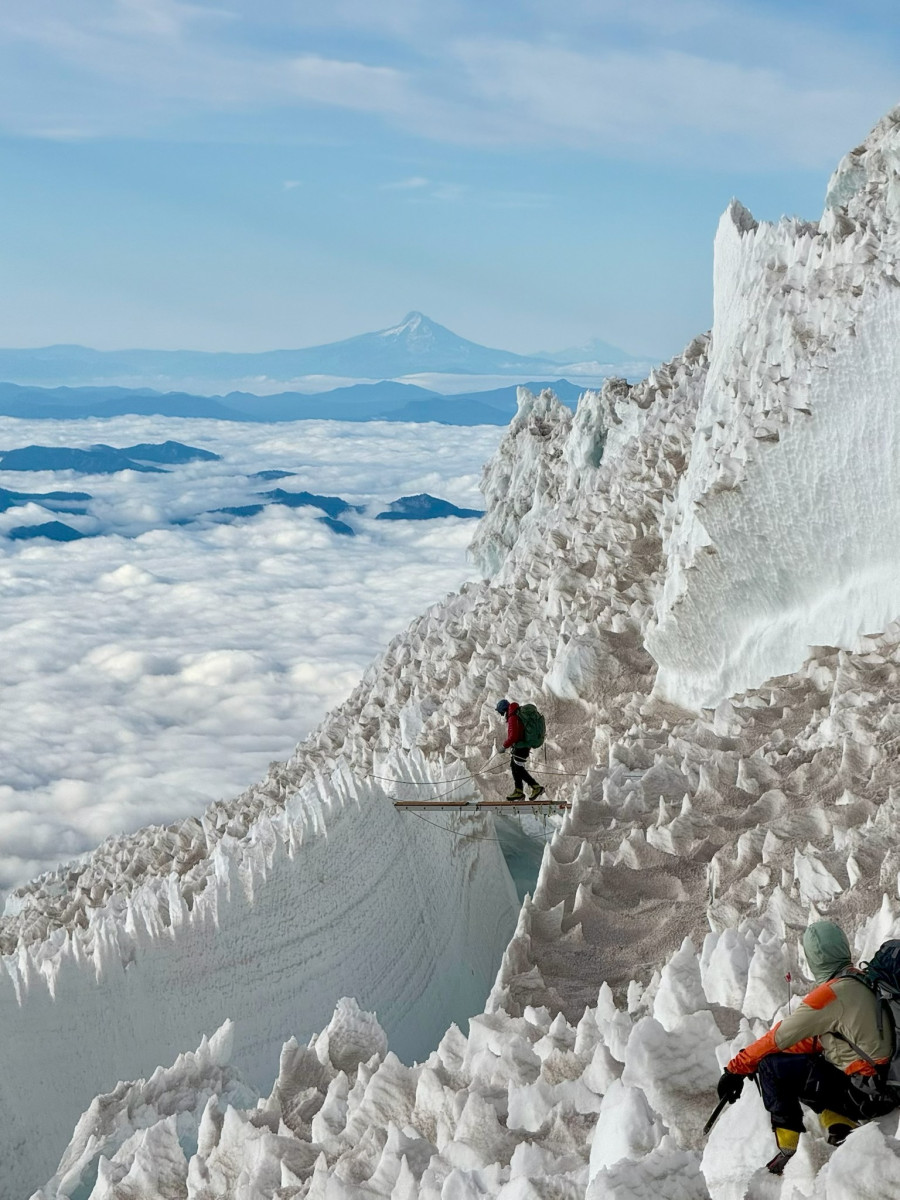
Probably the least understood of the three elements, the route to the summit may change 25 times or more per season from small variations to major adjustments. When the route no longer connects to the summit, we refer to it as “the route going out”. This can happen for many reasons, such as crevasse bridges opening. Our guide team (along with other guide services), will work to find a route variation or new route. While we are quick to respond (the response time is also weather permitting), there may be multiple teams that do not reach the summit while the route is out even if the weather is favorable. Like the weather, we don’t know when the route will go out and how long it may take to repair or find a new route. We have often repaired the route in 1-2 days, but longer outages are not uncommon, and there is a chance that poor route conditions will prevent a summit attempt, in good weather conditions.
Our feedback from climbers, when the route “goes out” has been overwhelmingly positive because we can provide different options instead of a summit attempt. Sometimes we climb as high as we can see if we can make the route go, while other times we will spend a day working on technical mountaineering skills like ice climbing.

Keeping the Pace While Climbing Taquoma (Mount Rainier)
Tahoma is a physically demanding climb. You must be prepared to travel with your team at a speed of at least 1000 to 1200 vertical feet per hour.
- While many may climb at a faster pace, we feel setting a team pace is important to manage expectations and offer the chance for more climbers to summit when conditions permit. We understand this may be a slower pace than you are used to, but we believe this is the best approach and provides a more team-oriented experience.
- Please note, there are times when we may have to move more quickly through certain terrain, such as under areas of possible overhead hazard. Coming to the climb with the expected fitness level, helps us navigate the mountain and “speed up “when needed.
- 1000 + vertical feet per hour is a reasonable fitness level for climbing and obtainable for climbers who give themselves ample time to train and focus on sport specific training for mountaineering. Traveling at a slower pace (having longer days on the mountain leads to increased fatigue on your body and higher risk). It is not an option to turn a 6 hour climb day into an 8+ hour climb.
- We do not have fast or slow rope teams – our teams keep a steady pace and move together for risk management purposes.
- Traveling very slowly on a climb like Tahoma (less than 1000 vertical feet per hour) makes each section of the climb longer, resulting in greater overall fatigue for the climber, including physical stress and thus our need to keep at least this pacing.
Climbing Season on Rainier
Historically the Rainier climbing season was more predictable with mid-June – mid August presenting the best combination of reasonable weather and variable climbing route. With climate change and glacier recession conditions have introduced more variability for this time period and we have noticed a less predictable “prime season” over the past 5 years. For example, in May 2022 climbers had a 60% success rate, while in July 2024 it dropped to 45%. Even in 2025, success rates fluctuated sharply, from 90% in June to 60% in August, highlighting the mountain’s dynamic nature. Regardless of the season, every trip may encounter unique weather challenges. Our seasoned guides and Field Director, who have extensive experience on Mount Rainier, work diligently to monitor conditions daily, ensuring that each trip has the best possible chance for a successful summit.
We encourage you to use our blog posts to keep updated on climbing conditions. We do not cancel trips due to potential weather situations or while the climbing route is being rerouted.